
Seasonal Species Directory for Thrupp Lake
Thrupp Lake is a small inland water body on the edge of Radley, south of Oxford, forming part of a mosaic of gravel workings, scrub, rough grassland and wetland habitats associated with the Thames corridor. Although modest in scale, the lake supports a surprisingly varied seasonal bird assemblage, with species composition shifting throughout the year in response to migration, wintering behaviour, breeding activity and changing detectability.
Unlike the more curated Year in the Life of Abingdon project, which aims to present a broad narrative portrait of place, this directory takes a more analytical approach. It acts both as a seasonal field catalogue and as an exploratory ecological observatory — examining how species use the site across the annual cycle and how those patterns relate to one another.
The directory itself is organised as a structured seasonal reference, but beneath that sits a second layer of interpretation based on long-term observational data and computational analysis. Monthly occurrence patterns have been modelled and compared across species to explore broader ecological structure within the Thrupp Lake bird community.
One of the most revealing outputs of this work is the species similarity analysis shown below.
Seasonal Similarity and Ecological Structure
The dendrogram groups species according to the similarity of their annual seasonal behaviour rather than taxonomy or habitat alone. Species are clustered based on the shape of their yearly occupancy and detectability patterns — effectively asking:
Which birds use the lake in similar seasonal ways?
This produces ecological assemblages that broadly correspond to recognisable field experience at the site.
- Winter visitors such as shoveler and pochard cluster together through their strong cold-season occupancy and autumn arrival signatures.
- A large resident assemblage contains species that remain present through much of the year but show strong seasonal detectability shifts.
- More specialised seasonal users, such as oystercatcher, form distinct isolated clusters reflecting narrow seasonal windows of occurrence.
- Certain species, such as egret, display sufficiently unusual annual structure to separate into their own ecological grouping.
Importantly, these clusters emerge from seasonal structure alone. Closely related species do not necessarily group together unless they share similar annual behaviour at the site.
The analysis also highlights interesting edge cases. Pochard, for example, behaves broadly as a winter visitor at Thrupp Lake, but with fragmented and intermittent occupancy rather than the continuous winter presence shown by more canonical wintering species. This may represent a weaker or more episodic form of winter site usage — an example of the kind of “non-canonical” seasonal regime that becomes visible through comparative modelling.
Dendrogram of Seasonal Similarity
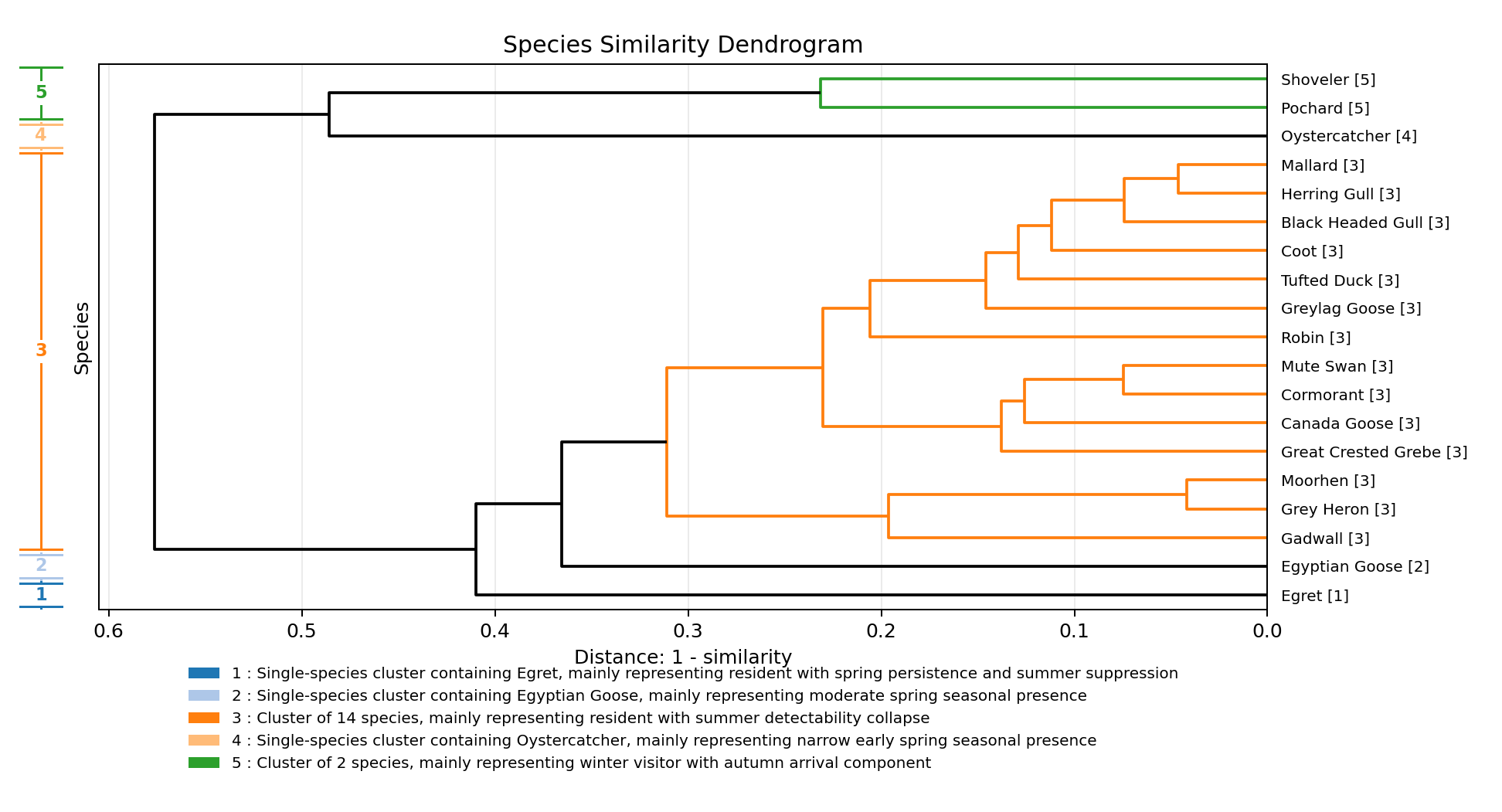
The dendrogram shows the hierarchical similarity relationships between species. Shorter branch distances indicate more similar seasonal structure.
Seasonal Ecological Calendar
To make these clusters easier to interpret, the mean annual activity pattern for each cluster is shown below as a seasonal calendar.
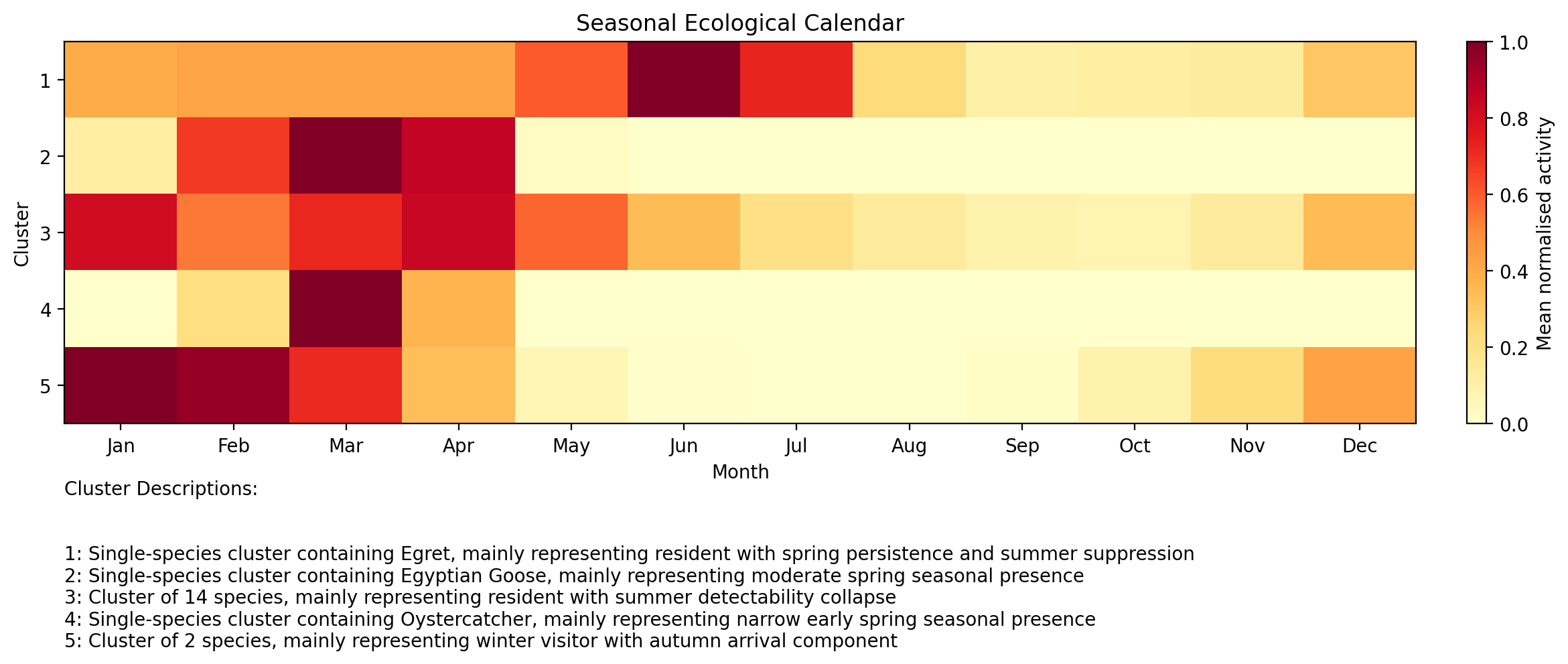
This reveals distinct annual “seasonal territories” occupied by different ecological groups within the lake community:
- Strong winter occupancy
- Spring arrival peaks
- Year-round resident persistence
- Summer detectability collapse
- Narrow migratory windows
Rather than simply listing species, the calendar begins to describe the annual ecological rhythm of the site itself.
Species Similarity Heatmap
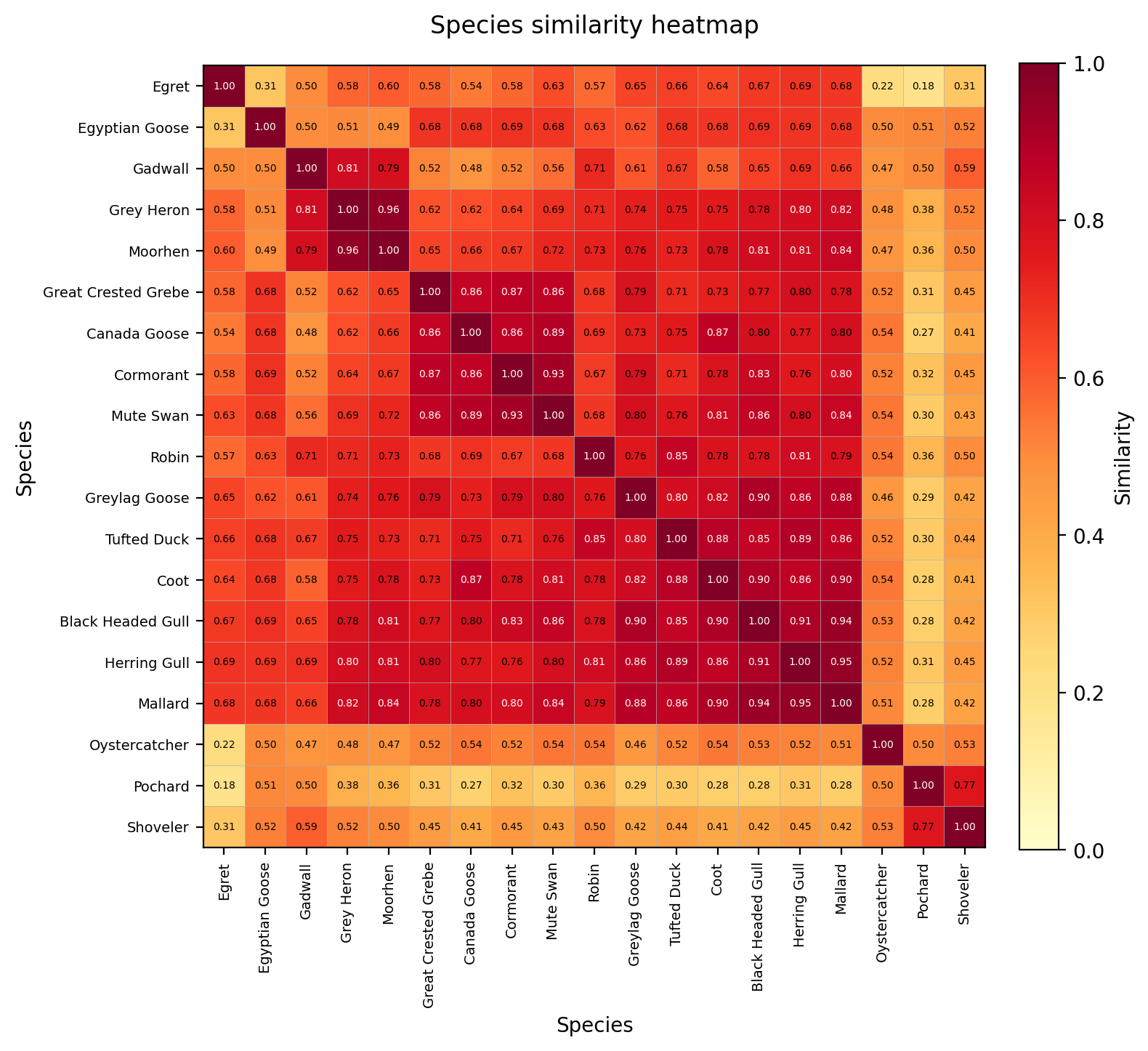
The similarity heatmap provides the underlying pairwise comparison matrix used to generate the clustering analysis. Darker values indicate species with more closely matching seasonal behaviour.
Although more technical in nature, the heatmap helps expose subtle relationships that are less obvious in the dendrogram alone. For example:
- Resident waterbirds form a broad zone of high mutual similarity
- Winter visitors remain comparatively isolated from resident assemblages
- Certain species occupy intermediate or ambiguous positions between ecological regimes
Taken together, these analyses begin to reveal the latent seasonal structure of the Thrupp Lake bird community — not simply which species occur there, but how the lake is used through time.
The pages that follow allow exploration of individual species accounts and seasonal patterns across the site’s bird assemblage.
Browse by group
These species accounts are generated from the author's own long-term wildlife records and are intended as interpretive summaries of seasonal pattern rather than formal survey outputs.