IN-2026-016 - Common Nettle (Urtica dioica) - Leaf (W.M.)
Specimen & Context
| Date | 2026-04-07 |
| Species | Urtica dioica |
| Common Name | Common Nettle |
| Material | Fresh leaf (margin and surface regions) |
| Location | Abingdon, Oxfordshire, UK |
| Preparation | Leaf, Whole Mount (Dry and Water Mount) |
| Stain | None |
| Series | Scheme of Structural Investigations - Series I — Surface & Exchange |
Overview
This investigation examines the surface structures of a leaf of Urtica dioica, with particular attention to the morphology and arrangement of stinging trichomes.
The aim was to observe the form, attachment, and distribution of these structures, and to compare their appearance under dry and water-mounted conditions.
The specimen represents actively growing foliage, with well-developed surface structures suitable for direct observation.
Method (Summary)
- Small portions of leaf margin were excised using a single-edged razor blade
- Specimens were mounted by two methods:
- Dry mount (no medium, minimal coverslip pressure)
- Water mount (mounted in a drop of water under coverslip)
- Coverslips were applied carefully to avoid deformation of the trichomes
- No staining was used
- Illumination was primarily transmitted light, with oblique adjustment via mirror
- In one instance, additional incident light (desk lamp) was introduced to explore surface reflection
Plate Groups
| Plates | Mount Type | Description |
|---|---|---|
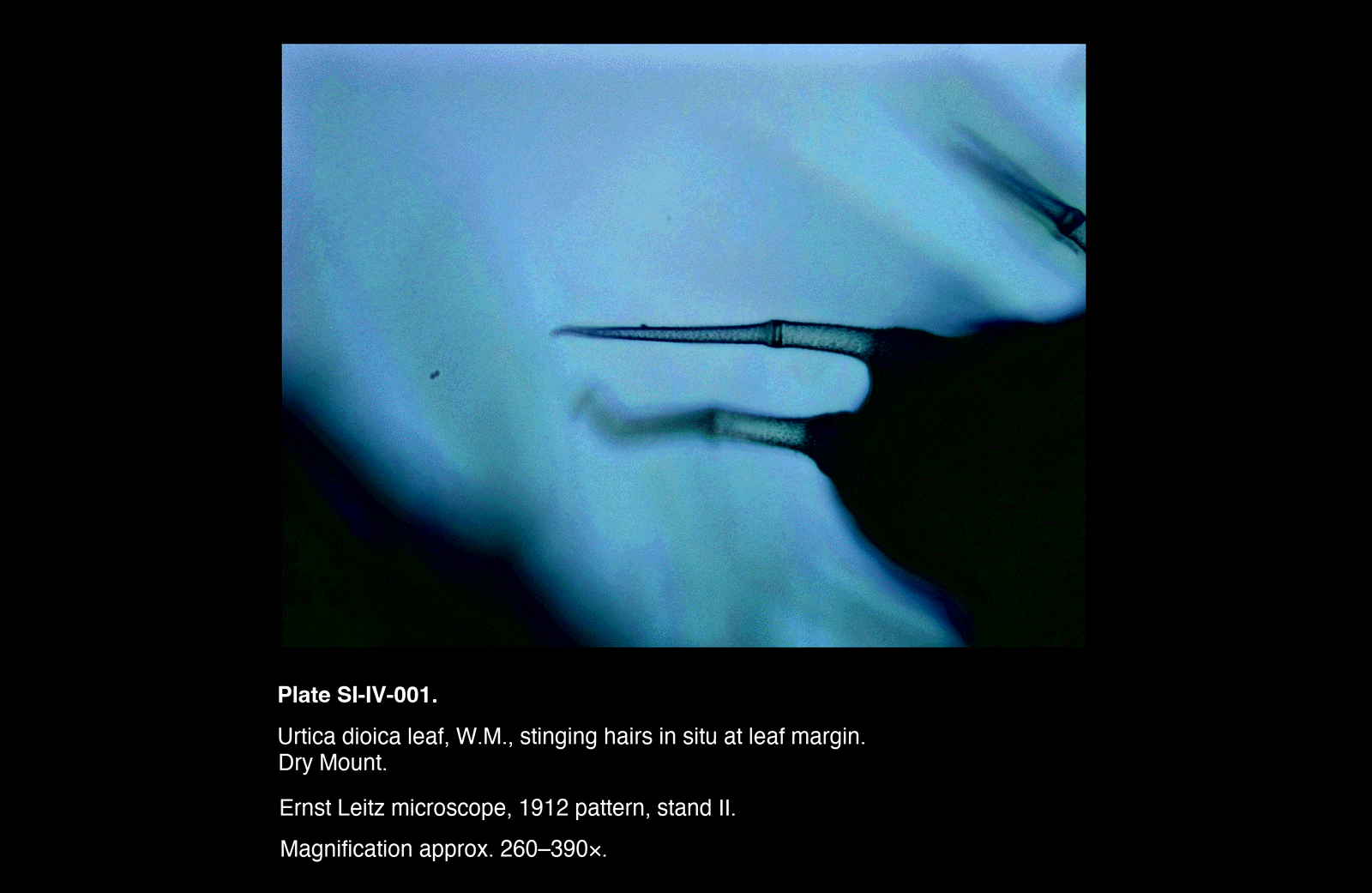
| SI-IV-001 | Dry | Leaf margin with hairs in situ |
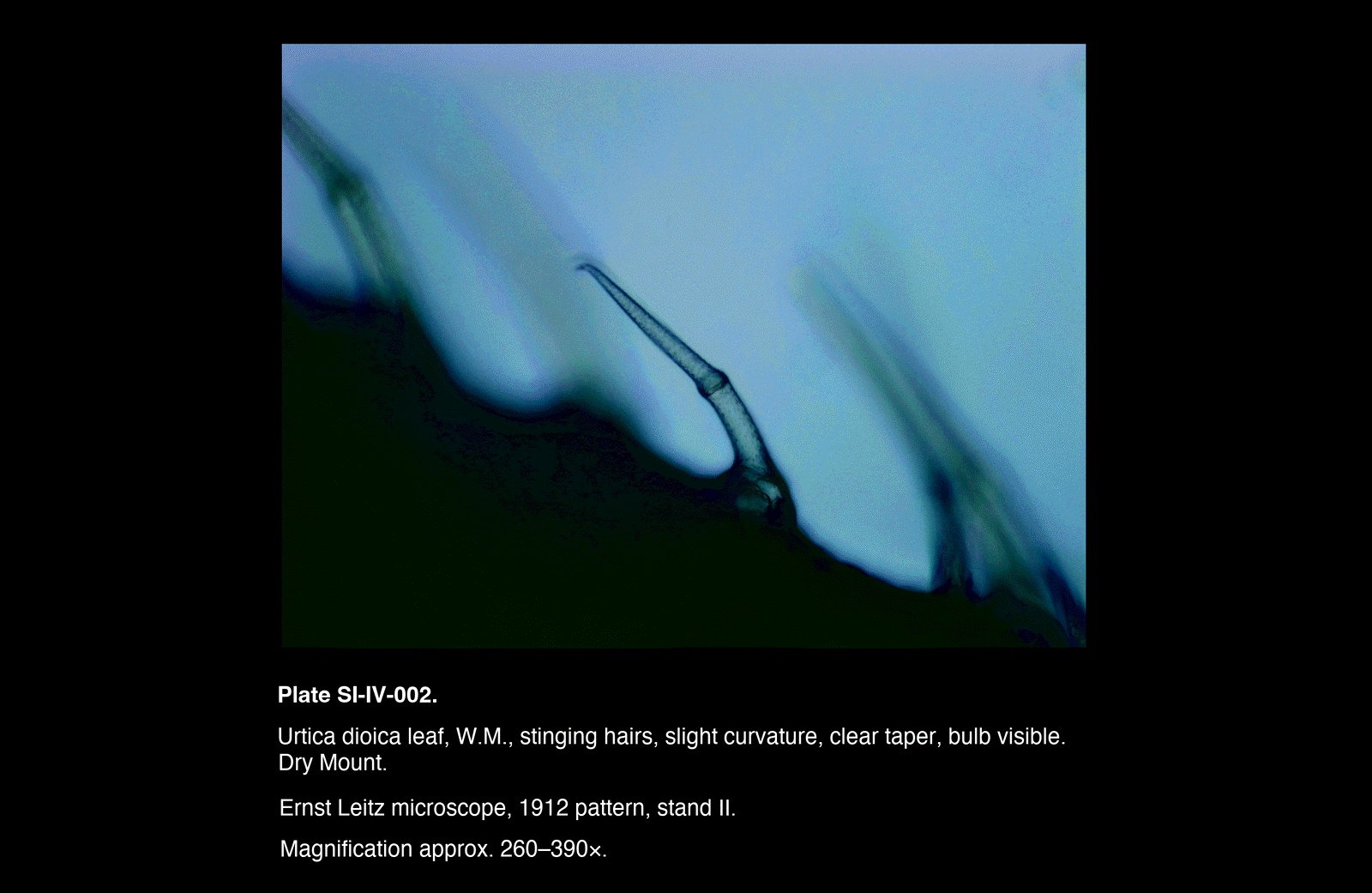
| SI-IV-002 | Dry | Individual hairs showing curvature and taper |
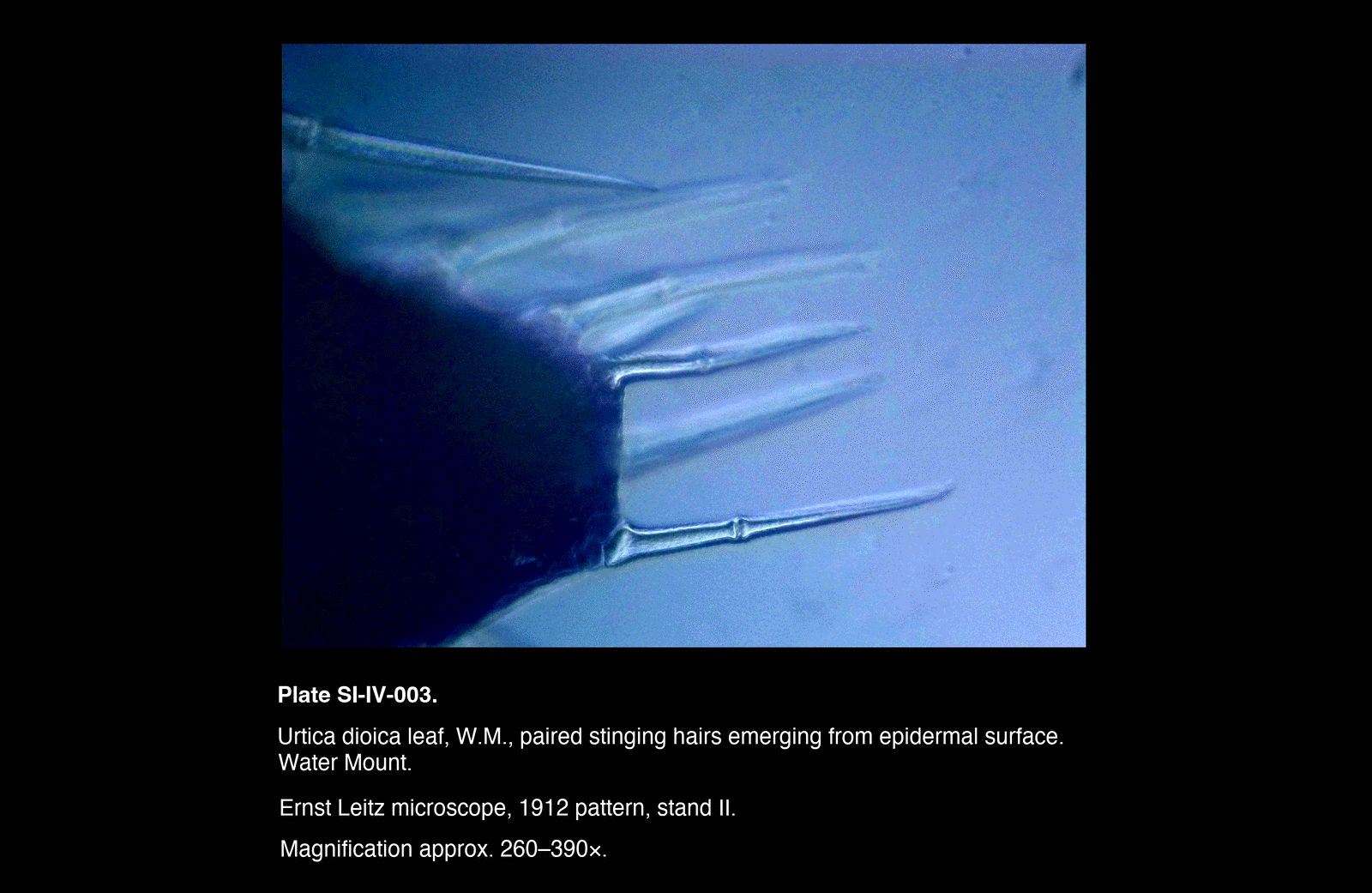
| SI-IV-003 | Water | Paired hairs emerging from epidermal surface |
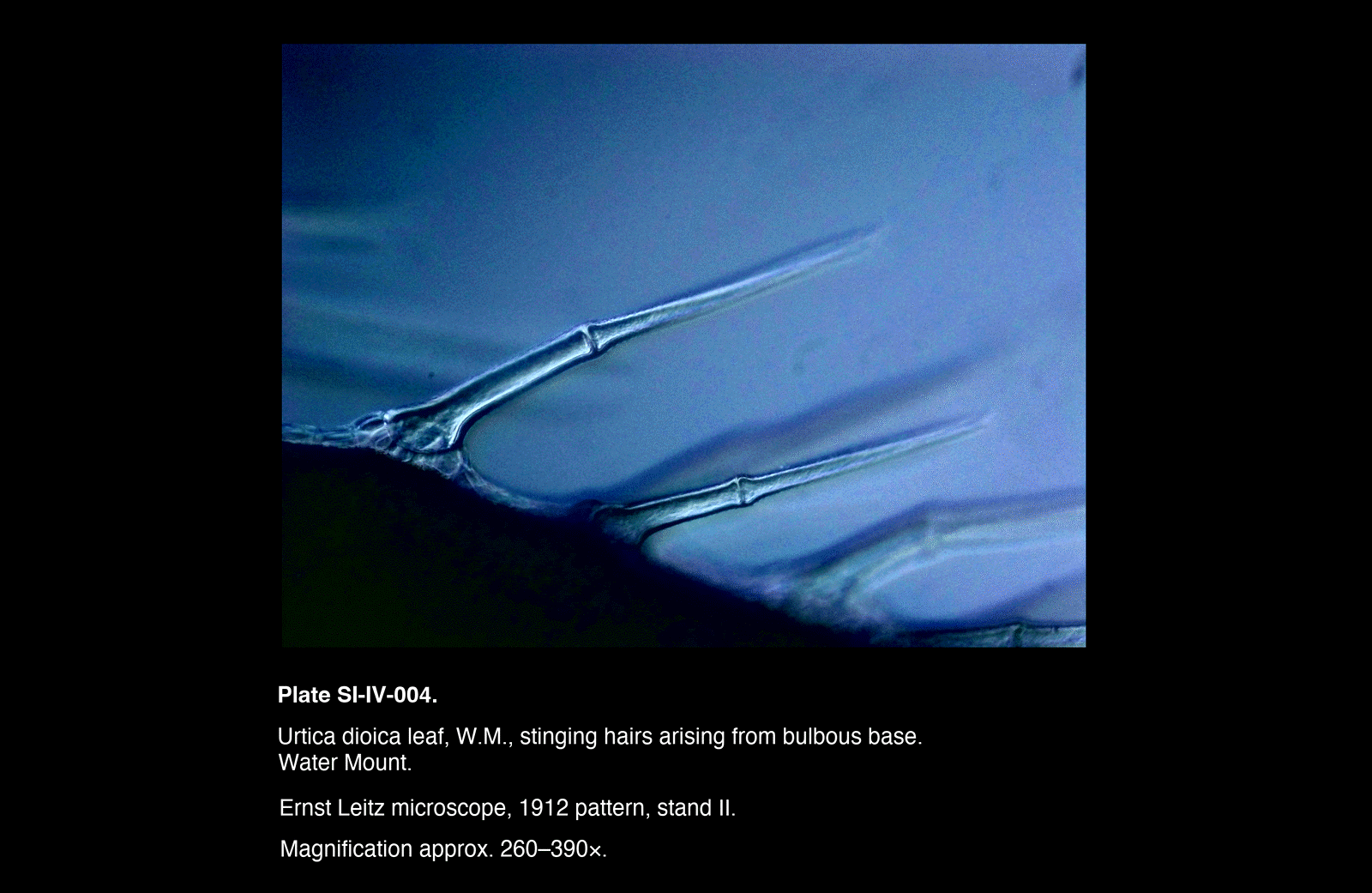
| SI-IV-004 | Water | Hairs arising from bulbous bases |
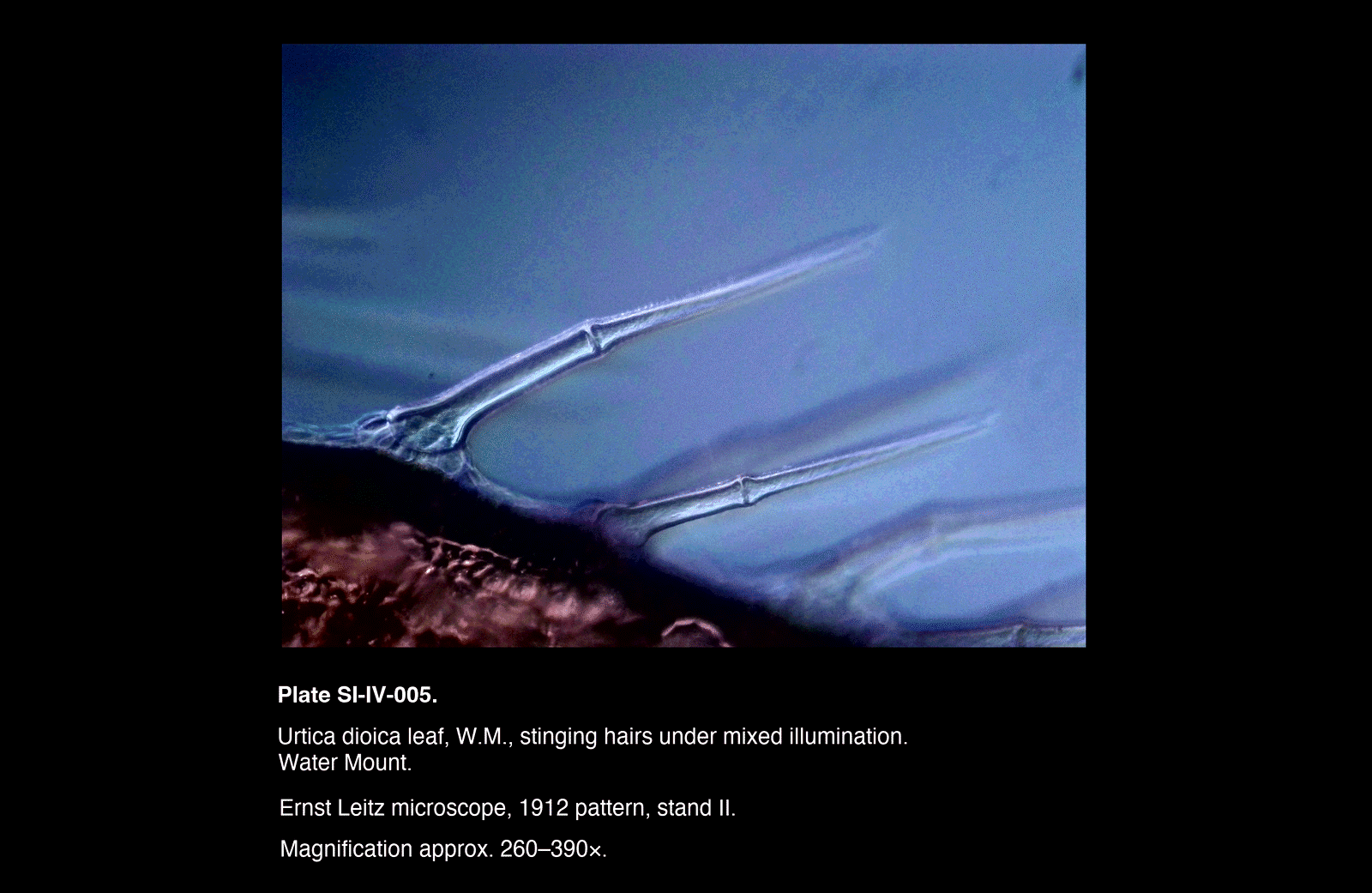
| SI-IV-005 | Water | Hairs under mixed illumination |
Plates
/Urtica%20dioica%20leaf,%20W.M.,%20stinging%20hairs%20in%20situ%20at%20leaf%20margin)
/Urtica%20dioica%20leaf,%20W.M.,%20stinging%20hairs,%20slight%20curvature,%20clear%20taper,%20bulb%20visible)
/Urtica%20dioica%20leaf,%20W.M.,%20paired%20stinging%20hairs%20emerging%20from%20epidermal%20surface)
/Urtica%20dioica%20leaf,%20W.M.,%20stinging%20hairs%20arising%20from%20bulbous%20base)
/Urtica%20dioica%20leaf,%20W.M.,%20stinging%20hairs%20under%20mixed%20illumination)
Plates
Observations
Surface Distribution (SI-IV-001)
- Stinging hairs project outward from the leaf margin
- The shafts show slight curvature and taper evenly toward fine terminal points
Individual Hair Form (SI-IV-002)
- Individual hairs show slight curvature along the shaft
- A gradual taper from base to apex is evident
- The basal region appears expanded relative to the shaft
Emergence from Epidermis (SI-IV-003)
- Hairs arise individually from the epidermal surface
- Bases are clearly demarcated from surrounding tissue
- Adjacent hairs may occur in close proximity with similar orientation
Basal Structure (SI-IV-004)
- Each hair originates from a distinct bulbous base
- A transition is visible between the expanded base and narrower shaft
- The shaft maintains a consistent cylindrical form beyond this point
Illumination Effects (SI-IV-005)
- Under combined transmitted and incident light, hair surfaces show enhanced reflection
- Shaft contours and boundaries are accentuated
- The underlying epidermal surface becomes more apparent in reflected light
Interpretation
Stinging Trichomes
The observed structures are interpreted as stinging trichomes, specialised epidermal outgrowths characteristic of Urtica dioica.
Their form is defined by:
- A bulbous base
- A narrow, elongated shaft
- A fine, tapering terminal region
This morphology is consistent across both mounting methods.
Attachment and Orientation
The consistent emergence of hairs from discrete points on the epidermis indicates that each trichome is a distinct cellular structure.
Their outward orientation, particularly along the leaf margin, suggests a role in surface defence.
Effect of Mounting Method
Comparison of dry and water mounts shows:
- Dry mounts preserve the natural rigidity and straightness of the hairs
- Water mounts enhance visibility of internal structure and wall definition
- Minor curvature and softening of outlines may occur in water
These differences reflect the physical interaction between the specimen and mounting medium rather than changes in underlying structure.
Optical Behaviour
The introduction of oblique and mixed illumination reveals:
- Strong edge contrast along the hair walls
- Increased visibility of surface contours under reflected light
This highlights the optical properties of the hair walls, which appear smooth and refractive.
Functional Considerations
The combination of:
- Elevated position on the surface
- Slender, tapering form
- Distinct basal attachment
is consistent with a defensive function, enabling contact with external agents at the leaf surface.
Remarks
- The dry mount preparations (SI-IV-001, SI-IV-002) are particularly effective in preserving overall form
- Water mounts (SI-IV-003 to SI-IV-005) provide improved visibility of structural detail at the base and along the shaft
- The use of mixed illumination (SI-IV-005) demonstrates the value of simple optical variation in revealing surface features
- The investigation provides a clear introduction to surface structures within Series I/IV (Surface & Exchange), focusing on defensive adaptations rather than exchange processes