
Field Notes Journal Entry
Ecological Homesickness
Reflections on African landscapes, ecological scale, and the lingering emotional pull of places that feel profoundly alive
Ecological Homesickness
There are certain wildlife sequences on television that I now struggle to watch without feeling unexpectedly emotional.
Recently it was painted dog pups in the Kalahari. A few minutes of footage: movement around the den, adults returning through dry grass, low orange light spreading across the landscape. Beautifully filmed, certainly, but the reaction felt oddly disproportionate for a man sitting quietly in an Oxfordshire living room.
And yet the feeling was entirely real.
I have wondered, occasionally, whether this is simply middle age drifting into sentimentality. But I suspect it may be something slightly different.
A few years ago, we travelled to Tanzania. For me, the journey carried a significance beyond ordinary travel. Ever since watching David Attenborough’s Life on Earth as a boy, East Africa had occupied a permanent corner of the imagination: acacia silhouettes at dusk, distant herds moving through dust, immense skies over dry country. A place that seemed impossibly far away and strangely familiar at the same time.
The reality, when it finally came, was stranger than expectation.
It was not simply the wildlife, remarkable though that was. Nor was it only the scenery. It was the overwhelming sense of inhabiting a living system operating at immense scale.
Weather mattered there. Light mattered. Distance mattered. Dawn and dusk mattered. Animal movement mattered. One became aware, almost constantly, of ecological processes unfolding across the landscape: birds moving along the shoreline, baboons calling from trees at first light, distant columns of dust over the plains, the changing sound of insects as darkness gathered.
Modern life rarely asks us to pay attention in that way.
Lake Eyasi remains particularly fixed in memory.
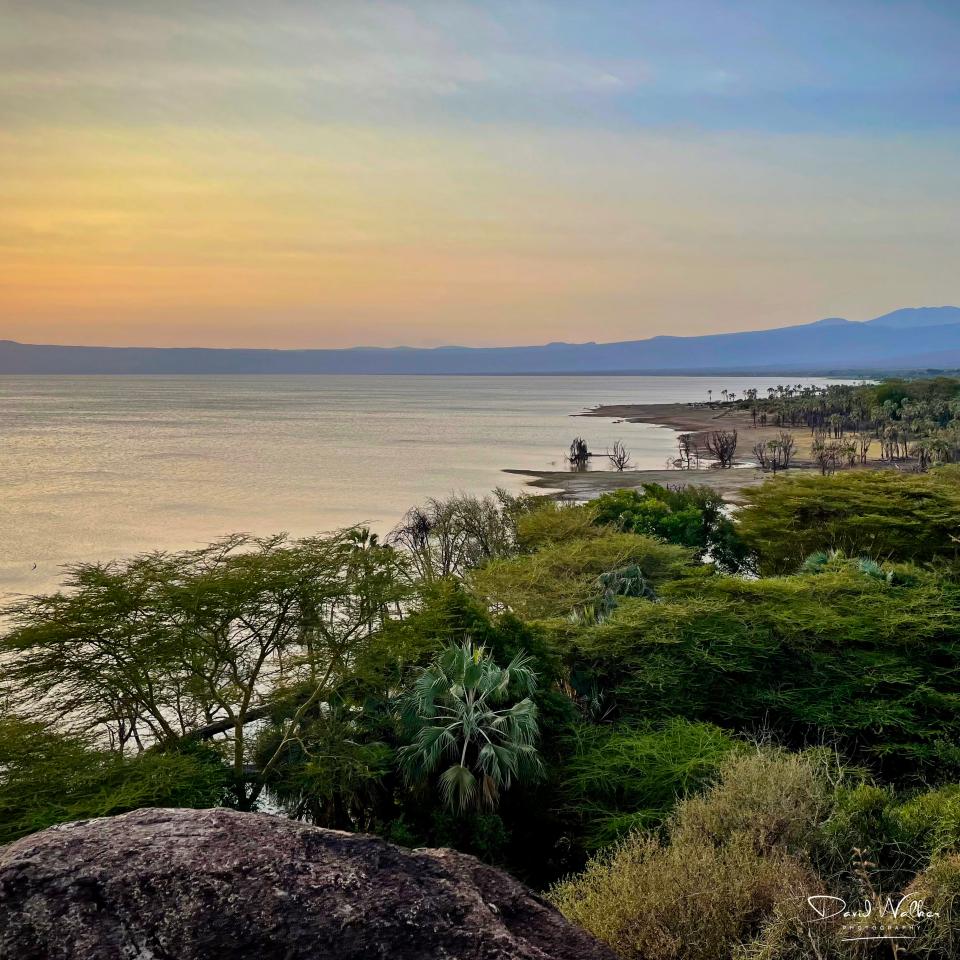
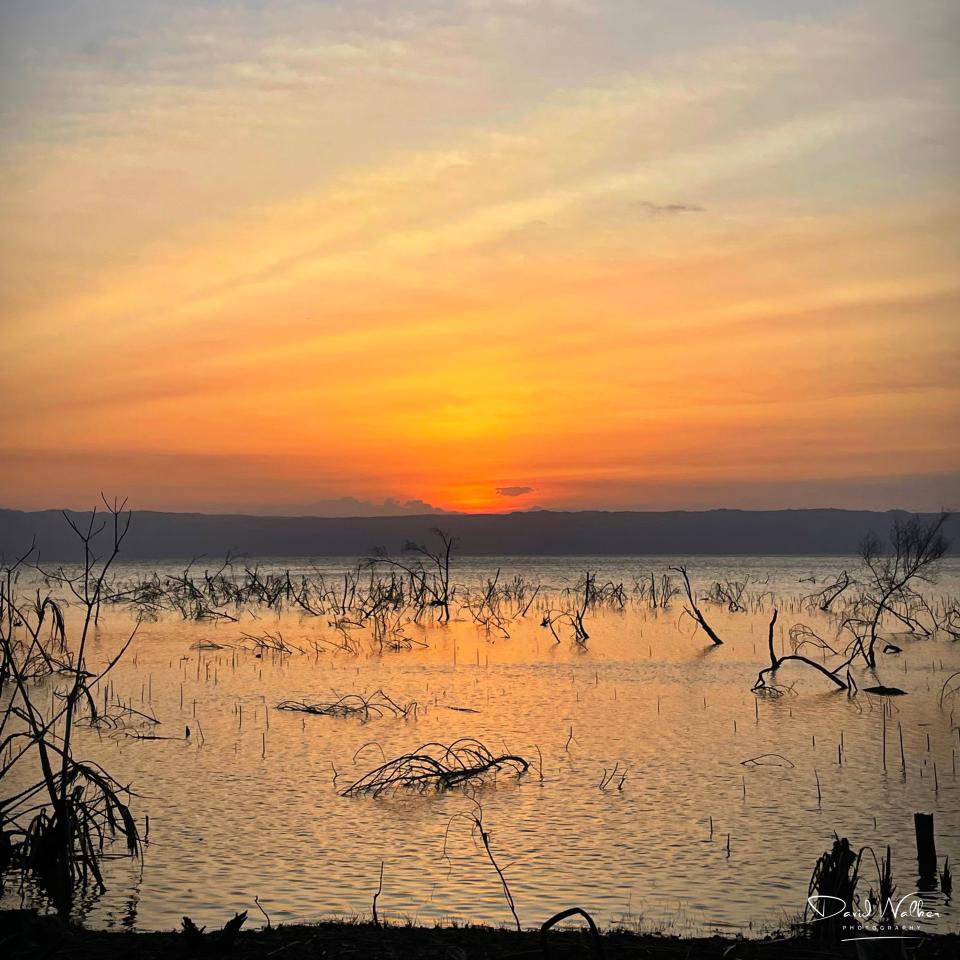
At sunset the lake became almost metallic in colour, drowned trees standing black against orange water while the escarpment darkened into silhouette beyond. The evening air cooled. Bird calls thinned out one by one. Gradually, the whole landscape settled into silence.
Years later, I still remember something Mariana, the owner of Kisima Ngeda Lodge, said to us there. She had grown up on the Pampas of Argentina, itself a landscape of openness and distance, but after first visiting Africa as a backpacker she found herself unable to stay away. Eventually she returned permanently, unable to resist the scale of the landscape.
I think I understand now what she meant.
There is something about African landscapes that alters one’s internal sense of proportion. The horizons are immense. Weather becomes visible at distance. Light arrives and departs theatrically. Even silence feels larger somehow. One becomes conscious, in a way difficult to describe afterwards, of existing within a living world that is continuing entirely on its own terms.
Since returning home, I have occasionally experienced what I can only describe — cautiously, because the phrase risks sounding overblown — as ecological homesickness. Not homesickness for tourism or travel itself, but for immersion in a landscape that felt profoundly alive.
Perhaps certain places simply alter us slightly.
Or perhaps modern life leaves so little room for sustained attentiveness to the living world that, when we finally encounter it fully, the experience embeds itself more deeply than expected.
I sometimes wonder whether many of us quietly lose the capacity for awe towards ordinary non-human existence. Not intentionally. Life simply becomes increasingly mediated, accelerated, illuminated, scheduled and abstract. Seasons continue outside the window while attention turns elsewhere.
Field observation, at its best, may partly be an attempt to resist this flattening. To remain attentive. To notice migration, flowering, feeding behaviour, dusk light, first arrivals, final departures. To remember that human life still exists within larger living systems rather than apart from them.
Perhaps that is why images of painted dogs at dusk can still produce an unexpectedly emotional response years later.
Or perhaps part of me simply never completely came back from Africa.